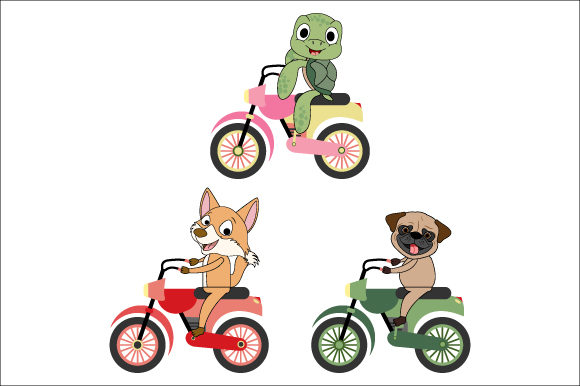
Animal Illustration Design of Riding a Motorcycle
A playful, bold silhouette that leans into personality—not perfection
First glance at the Animal Illustration Design of Riding a Motorcycle tells you this isn’t a stiff vector clipart piece. It’s got swagger—think a confident fox or raccoon leaning into the wind, helmet on, tiny paws gripping handlebars, tail streaming behind like a banner. The lines are clean but expressive, with intentional weight shifts and a slight forward tilt that implies motion. It doesn’t try to mimic realism; instead, it lands squarely in that sweet spot between illustrative charm and embroidery-friendly simplicity. That’s critical—because when you’re stitching this onto a canvas tote for your local boutique, or embroidering it onto a baby onesie as a quirky shower gift, readability matters more than fine fur texture.
Where this design earns its keep—in real projects, not just previews
I tested the Animal Illustration Design of Riding a Motorcycle across three actual production scenarios: a medium-weight cotton tote bag (for a small shop launch), a midweight French terry sweatshirt (custom order for a motorcycle club’s kid line), and a 3” embroidered patch sewn onto denim aprons for a craft fair vendor. In each case, the design held up—not because it was technically flawless, but because its visual hierarchy worked. The animal’s outline is strong, the motorcycle frame reads clearly even at 3.5”, and negative space around the wheels and handlebars prevents stitch crowding. That means fewer thread breaks, smoother satin-stitch transitions, and cleaner fill-stitch coverage on curved surfaces like cap fronts or pillow covers.
This isn’t a design for subtle branding—it’s built for recognition. A customer glancing at your Etsy listing will get the vibe instantly: fun, fearless, handmade. That translates directly to perceived value. When I added it to a holiday tea towel set as a “motorcycle pet” motif, buyers commented on how “joyful” and “unexpected” it felt—exactly the emotional hook small business owners need for gift-driven seasons.
Fabric and function: where to lean in—and where to pause
It shines on stable, medium-to-heavy fabrics: canvas, twill, fleece, denim, and midweight knits. On those, the Animal Illustration Design of Riding a Motorcycle reads crisply without heavy stabilizer dependency. But tread carefully with thin cotton voile, stretchy jersey, or tightly woven dark fabrics. Why? Because the design uses moderate stroke weight—not ultra-thin linework, but not thick cartoon outlines either. On dark fabric, you’ll want high-contrast thread (e.g., bright yellow or white) and possibly a light tear-away stabilizer underneath to prevent shadowing. And if you’re planning to stitch it on a curved surface like a baseball cap, test the hoop size first: the design’s horizontal span makes it less forgiving in small hoops (<4”).
Also worth noting: no tiny lettering or intricate interior details—so no risk of lost stitches in corners or dense fill zones. That’s a win for baby embroidery, where durability and washability matter. But don’t assume it’s automatic applique-ready. While the JPEG preview suggests clean edges, always open the SVG or EPS in your digitizing software to confirm path integrity before converting to an embroidery file. Not all vector exports translate cleanly to stitch logic without cleanup.
What this design says about your brand—and your customers’ expectations
Using the Animal Illustration Design of Riding a Motorcycle signals confidence in your aesthetic judgment. It’s not safe. It’s not generic. It tells customers you curate, not just compile. That builds trust—especially for personalized gifts and boutique merchandise. When someone orders a custom embroidered pillow cover with this design, they’re not just buying decor; they’re buying a story. And that story has to hold up after five washes, under gallery lighting, and next to other handmade products on a shelf or Instagram feed.
For Etsy sellers and craft fair vendors, it adds distinctiveness without demanding advanced technical skill. You don’t need specialty fonts or layered color schemes—just thoughtful thread selection and solid hooping. For digital product sellers, the inclusion of SVG 1.1, AI 10, EPS 10, and JPEG gives flexibility: use the vector files for mockups or rescaling, the JPEG for quick social previews, and know that your buyers can adapt it across platforms.
Practical notes every embroidery designer should run through
- Always stitch a test on scrap fabric—especially if using textured or dark material.
- Check thread color contrast before committing to a full run. What reads well on screen may vanish on navy fleece.
- Review stitch density in your embroidery software. If the fill areas look overly dense, reduce density slightly to avoid puckering on knits.
- Confirm hoop size compatibility before digitizing—this design stretches wider than it is tall.
- Inspect small details like wheel spokes or helmet visor lines at 200% zoom. Are they wide enough to stitch reliably?
- Test black-and-white mockups to see how it reads without color context—critical for printed product listings.
- Compare performance on light vs. dark backgrounds in your design workflow. Some elements gain or lose emphasis depending on contrast.
- Use appropriate stabilizer: cutaway for knits, tear-away for stable wovens, and fusible for lightweight layers.
- Verify licensing before selling finished items or bundling the design as part of a commercial embroidery file pack.
Final thought: This is a design that works *with* your process—not against it
The Animal Illustration Design of Riding a Motorcycle won’t replace your go-to floral monogram or minimalist logo—but it fills a very specific, very useful gap: spirited, scalable, and stitch-smart illustration for makers who want personality without production headaches. Whether you’re building a cohesive line of nursery decor, launching a small batch of custom apparel, or adding a signature motif to your Etsy shop’s bestsellers, it brings energy without sacrificing execution. It’s not just graphics. It’s a ready-made moment of delight—waiting for thread, fabric, and your next great idea.